JLPT N5 Kanji Practice: How to Learn All 121 Characters by Writing
A three-step way to practise JLPT N5 kanji that actually sticks — stroke order, tracing, then free writing — plus a printable 279-page workbook.

Most beginners meet a kanji, recognise it for a week, and then lose it. That is not a memory problem. Recognising a character and being able to produce it are two different skills, and reading alone only ever trains the first one.
This is a simple way to practise the JLPT N5 kanji so they stay — and the routine that makes it take about fifteen minutes a day.
How many kanji does N5 need?
The JLPT does not publish an official kanji list. In practice, N5 is usually put at around 100 to 130 characters — the ones behind everyday words like 山, 日, 人, 学, 食. Learn roughly 120 and you can read the N5 exam comfortably.
That number matters because it is small. At three new kanji a week you are finished in ten months; at three a day you are finished in six weeks. The problem is almost never volume. It is that people study kanji in a way that does not stick.
Why you forget kanji you already "learned"
Reading a kanji is recognition — your eye matches a shape it has seen before. Writing one is recall — you have to produce the shape from nothing. Recognition feels like learning while you are doing it, which is exactly why it is such a comfortable trap.
Writing forces you to notice things reading lets you skip: how many strokes, in what order, which part is the radical, how 土 differs from 士. Once your hand knows a character, your eye stops confusing it with its neighbours.
The three steps: stroke order → trace → free writing
Practise each kanji in this order. It takes a few minutes per character.
- Stroke order. Write it once slowly, following the numbered strokes. Japanese stroke order is consistent — top to bottom, left to right, horizontal before vertical — so learning it properly on the first hundred kanji means you can guess it correctly for the next thousand.
- Trace. Write over a light version of the character several times. This is where the proportions get into your hand: how far the 口 sits inside 国, where the centre line falls.
- Free writing. Cover the model and write it from memory in an empty square. This is the only step that is actually testing you. If you cannot do it, go back to step two rather than moving on.
If you are unsure which stroke comes first, the seven Japanese kanji stroke-order rules cover most beginner characters, with a stroke count and worked example for each one.
Use squared paper with a faint cross through the middle. Kanji are built around a centre, and writing them on blank lined paper is how you end up with characters that lean.
Learn kanji in groups, not in order
Studying kanji in list order — or worse, in stroke-count order — puts unrelated characters next to each other and gives your memory nothing to hold on to.
Group them by meaning instead: nature (山, 川, 田, 天, 気), time (日, 月, 年, 時, 分), people (人, 男, 女, 子, 父, 母), numbers, directions, verbs of daily life. Each group becomes a small story, and the words you can build inside a group reinforce each other.
Always practise kanji inside words
A kanji on its own has no reading. 山 is yama in 山登り, san in 富士山, zan in 火山. If you drill the character alone you will learn a meaning and no usable pronunciation.
So after the writing practice, write two or three words that use it, with furigana, and one full sentence:
- 山 (やま) — mountain
- 富士山 (ふじさん) — Mt. Fuji
- 火山 (かざん) — volcano
- 山登り (やまのぼり) — mountain climbing
日曜日に山に登ります。 — On Sunday, I will climb a mountain.
Reading that sentence out loud does two jobs at once: it fixes the reading, and it gives you a sentence pattern you can reuse.
A fifteen-minute daily routine
- Minutes 1–3. Review yesterday's kanji from memory, in empty squares. Do not look first.
- Minutes 4–10. Two or three new kanji: stroke order, trace, free writing.
- Minutes 11–15. Write one sentence per new kanji and read it out loud.
Then once a week, test the whole group with the model covered. The characters you miss are your real study list — everything else is already done.
A printable workbook for all 121 kanji
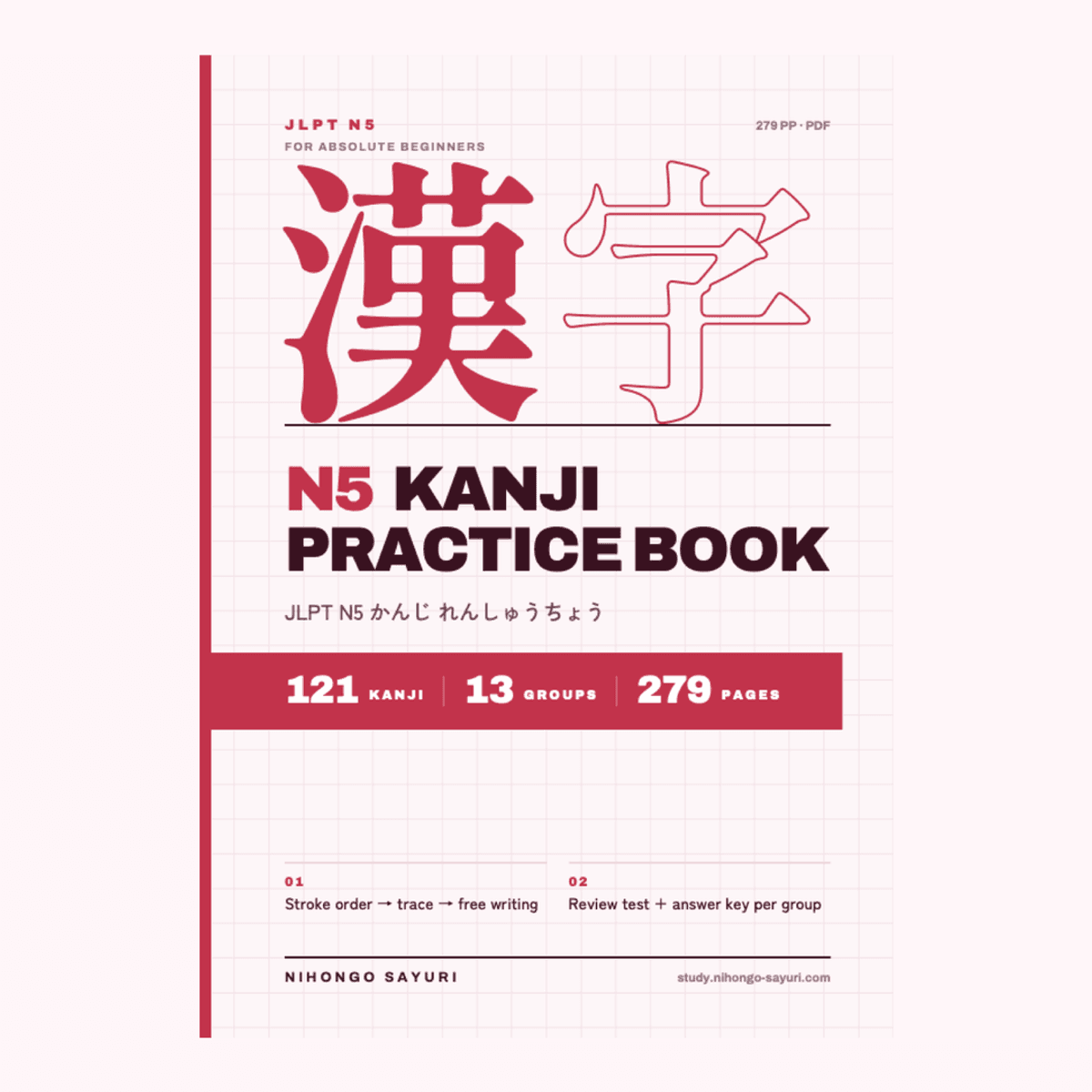
I put this routine into a workbook so you do not have to rule your own squares. The JLPT N5 Kanji Practice Book is a 279-page PDF covering all 121 kanji, arranged in 13 themed groups.
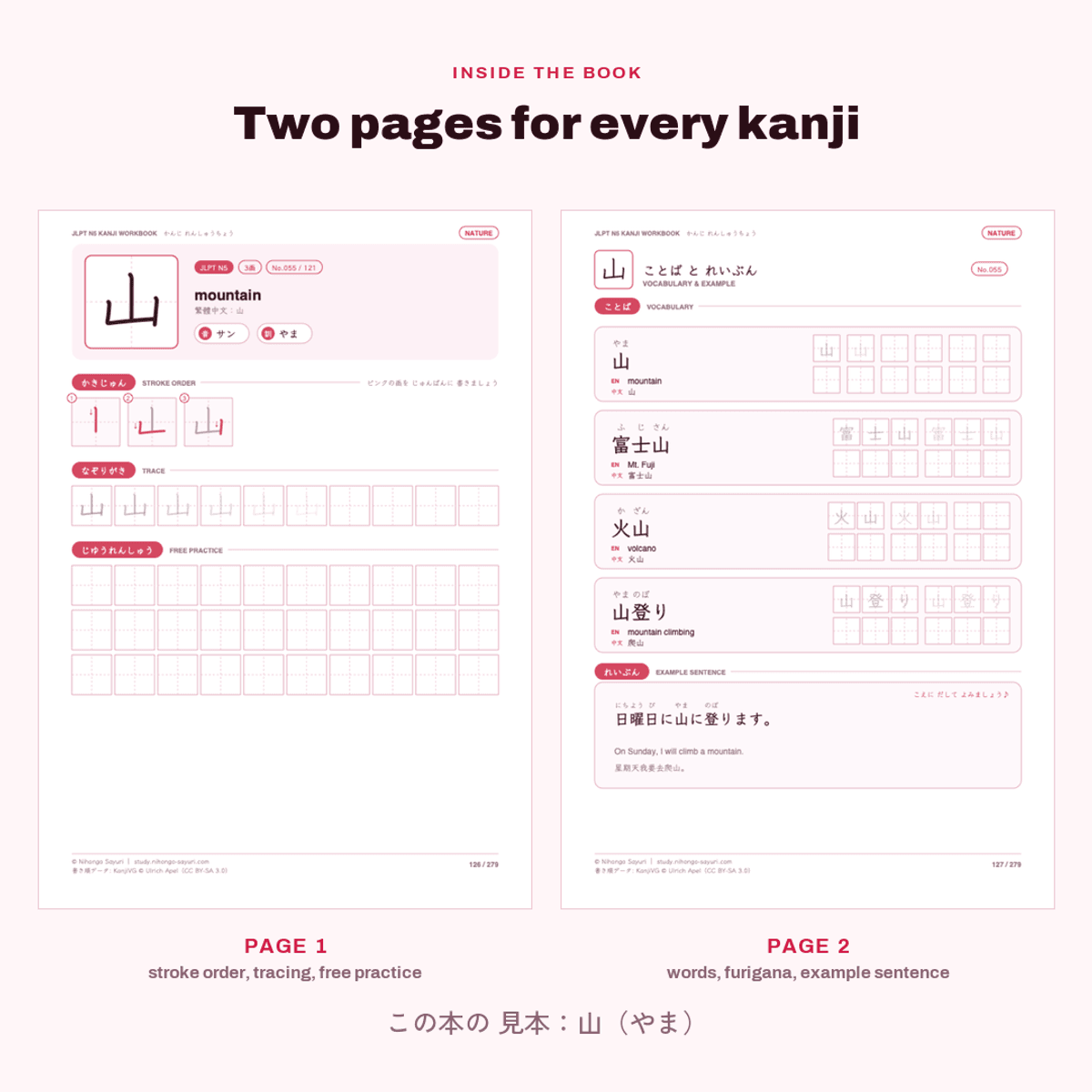
Each kanji gets two facing pages:
- Page 1 — meaning, stroke count, on'yomi and kun'yomi, the numbered stroke order diagram, a row of tracing squares, then a block of empty squares for free practice.
- Page 2 — three or four words built on that kanji with furigana and English and Chinese glosses, writing boxes for each, and an example sentence you can read aloud.
Every group ends with a review test and an answer key. It is a PDF, so you print the pages you need and print them again whenever you want another pass — which is the whole point, because one pass is never enough.
JLPT N5 Kanji Practice Book — 121 kanji, 13 themed groups, and 279 printable pages.
 sayuri
Would you rather practise with a teacher?
Writing practice is something you can do alone. Readings, and knowing which of two similar kanji a sentence actually wants, go faster with someone correcting you. I teach one-to-one online lessons, including kanji-focused ones, and I can explain in English or Chinese when the Japanese explanation is not landing yet.
See lessons and book a trial →
Level: JLPT N5.